5
Social platforms
InstagramFacebookTikTokYouTubeGoogle Business
Public profiles, posts and reviews. Follower counts, posting cadence, engagement, comments and ratings.
One platform for market intelligence and the customer conversations that follow.
Collection runs every morning; analysis scores what changed and flags it before anyone opens a dashboard.
Most teams we meet already do all of this. They do it on Sunday morning, by hand, for a handful of brands instead of the whole market, and the answer is a week old by the time it reaches the person who can act on it.
The comparison that matters is not Social Hub against another tool. It is Social Hub against the Sunday morning.
No survey panels and no estimates. Every figure on a Social Hub screen traces back to a page that was actually fetched.
Public profiles, posts and reviews. Follower counts, posting cadence, engagement, comments and ratings.
Prices checked every day, matched across retailers so the same item is one row.
The reply side of the same platform. One inbox, one customer record, whichever channel they arrived on.
Social Hub collects publicly visible market information. If a source cannot be read on a given day, the platform keeps the last good reading and our team is alerted to restore it.
Kuwait is a small market and reputations travel. Book a walkthrough and see Social Hub running on your own market before you decide.
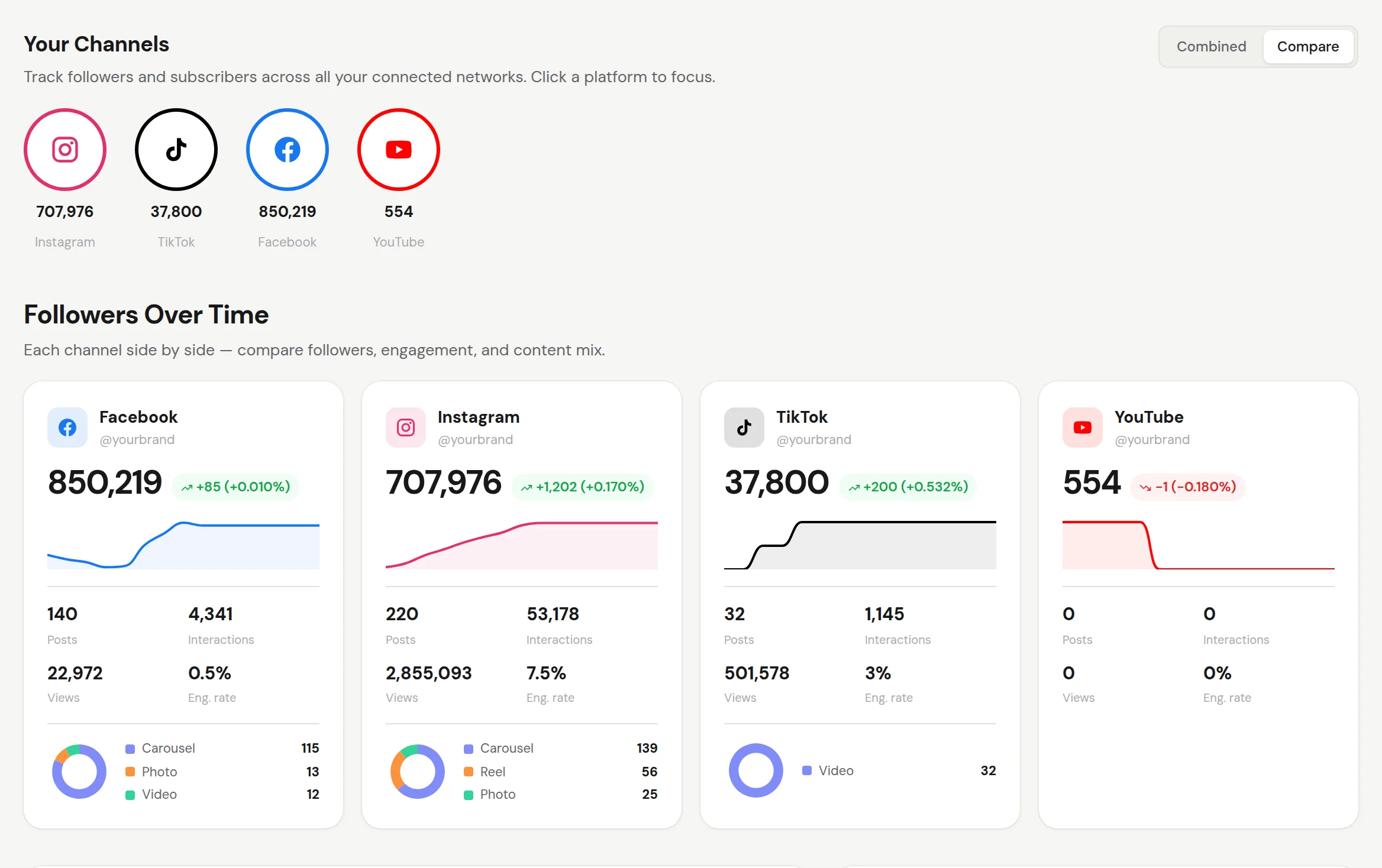
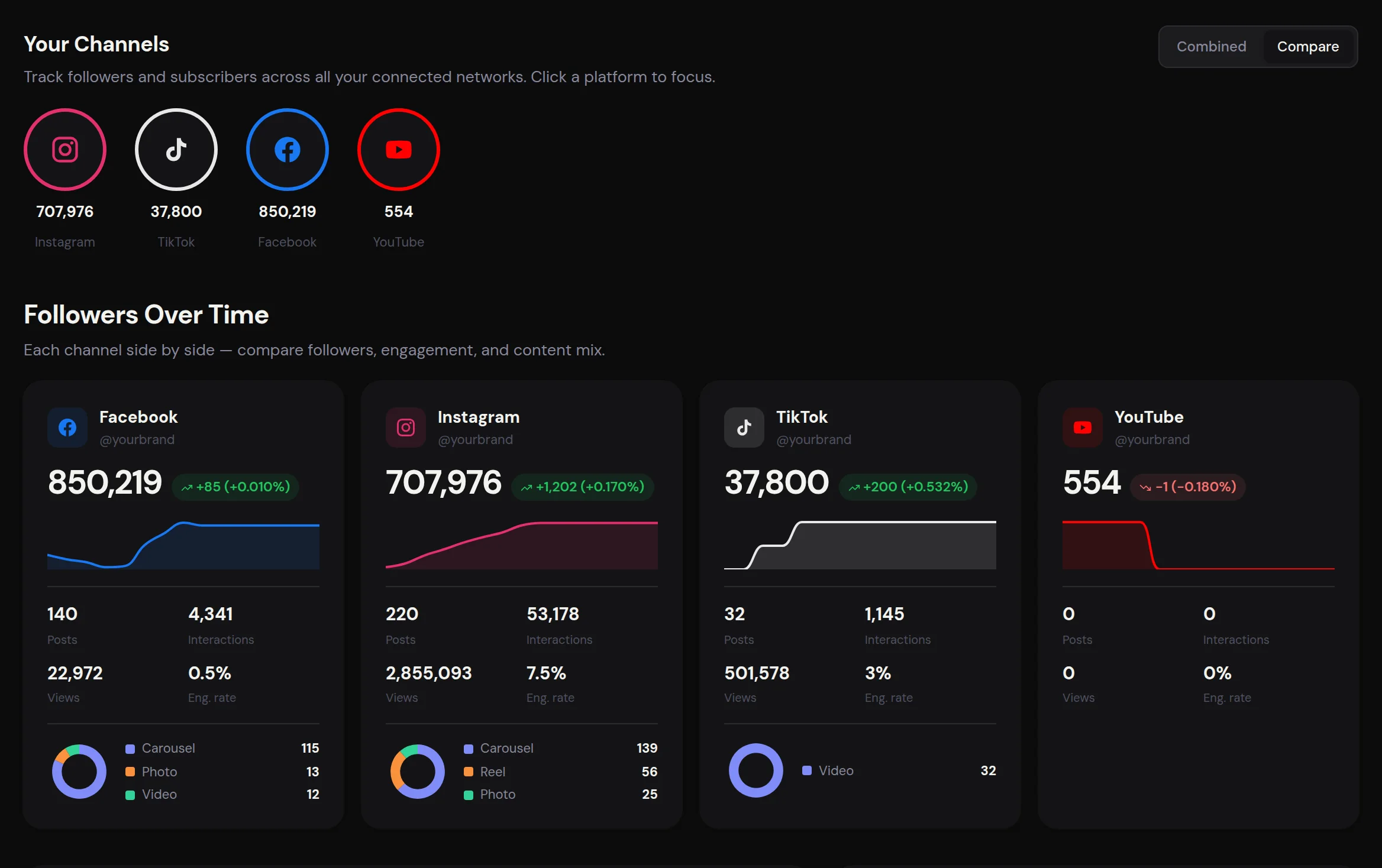
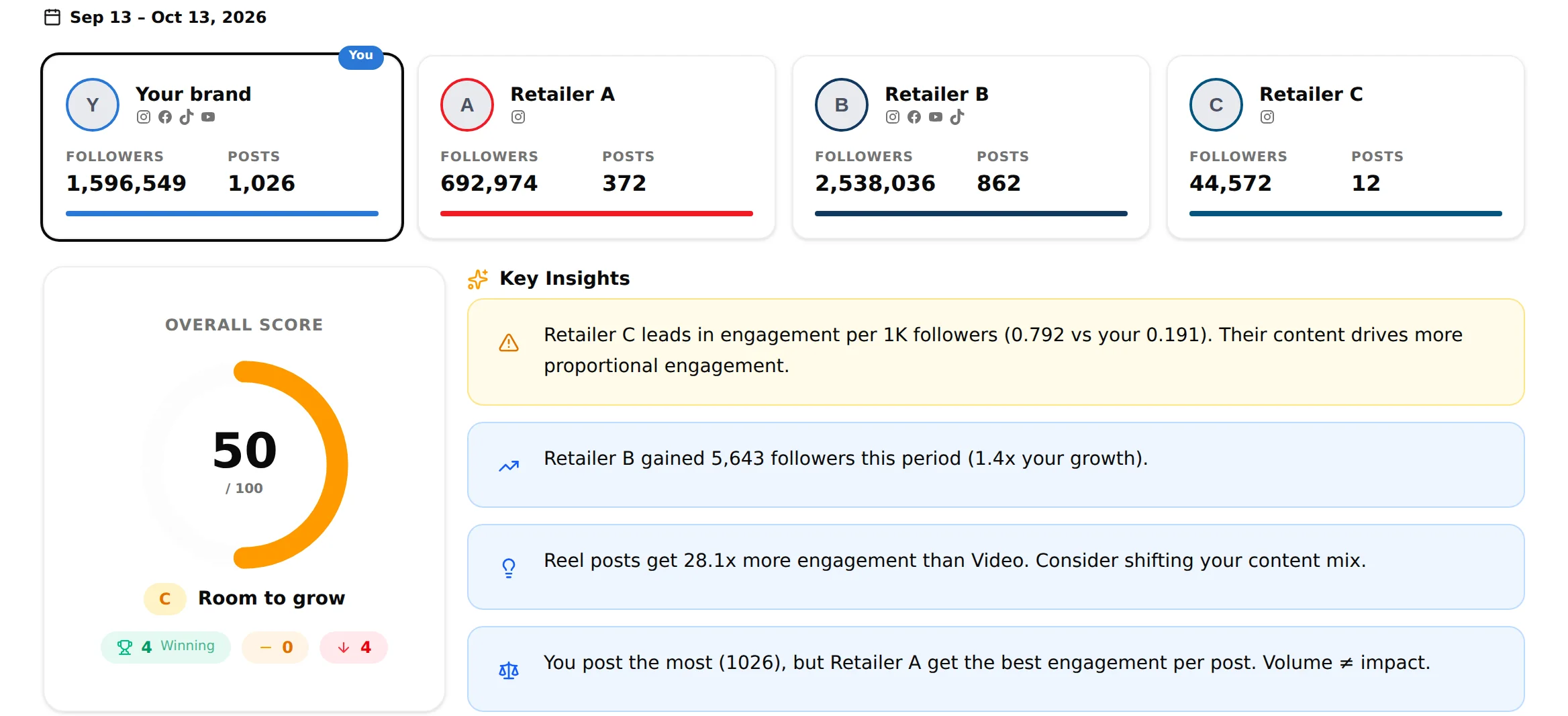
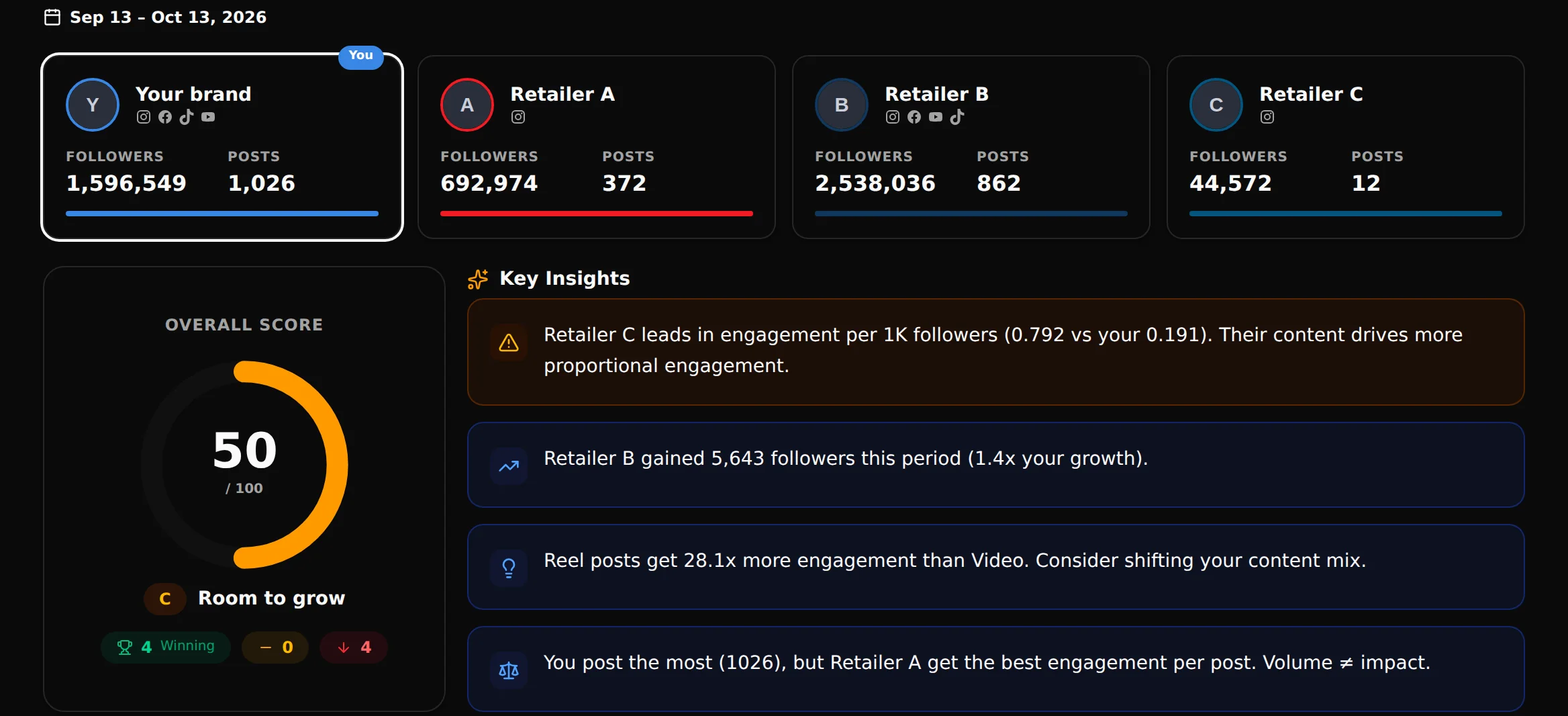
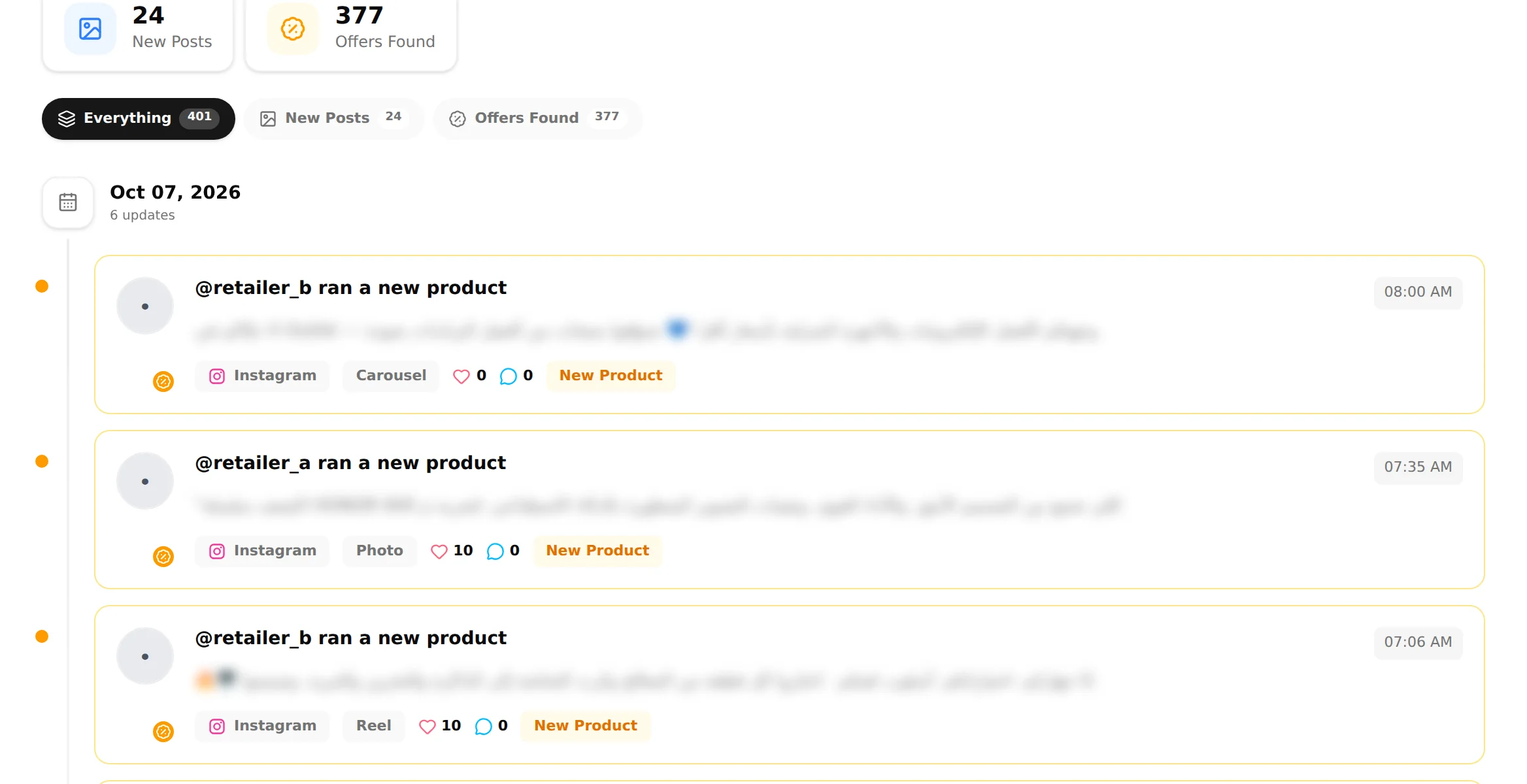
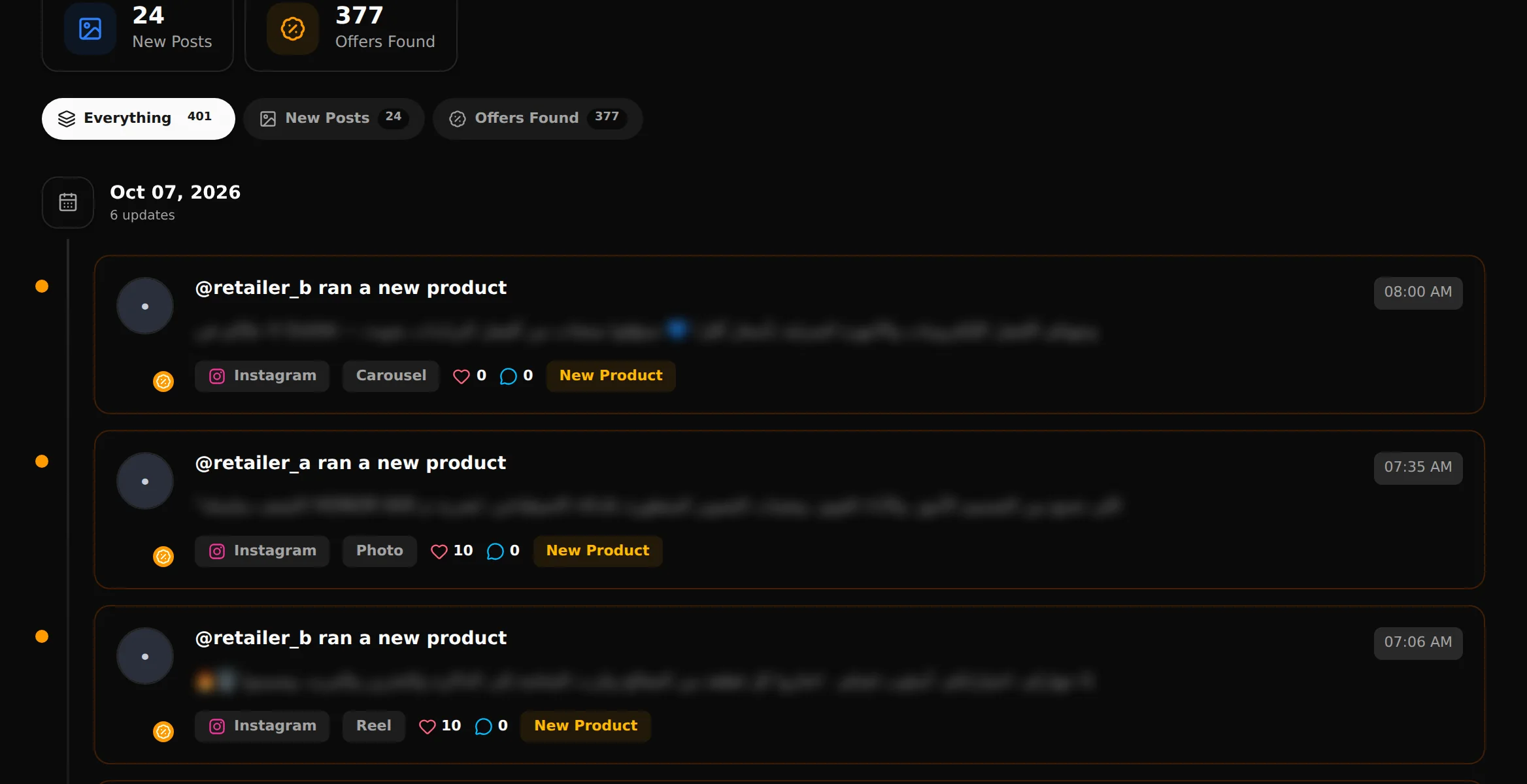
Customers are described by category rather than named.
See it on your own competitors.
Tell us the brands you follow and we will load them before the call, so the first thing you see is your own market.
Book a walkthrough →What you see from the first week.
In Arabic and English, from your own tracked data.
Benchmark puts your posting rhythm and engagement side by side with every competitor you track: no exports, no spreadsheets.
Head-to-head product comparison and audience credibility checks, on the accounts you track.
Read the guide →80,000+ products across Kuwait's leading retailers, checked every day, with delivery-app menu changes tracked alongside.
Every number the platform collects can carry a threshold. When one is crossed, the alert goes to the person who can act on it: not to a shared address nobody reads.
Percentage moves, absolute prices, stock state, mention volume, sentiment, response time. Per item, per source, per branch.
A price signal goes to commercial, a sentiment signal to the social lead, a response-time signal to the inbox owner. Each with its own quiet hours.
In-app, email, or a WhatsApp message to the person on shift. The alert carries the reading, the source and the timestamp that produced it.
Signals are deduplicated before they are sent: a price that oscillates across a threshold four times in an hour produces one alert with the range, not four alerts. Alert fatigue is the failure mode that kills monitoring tools, so the default settings are deliberately quiet.
Everyone can read a price tag. Social Hub reads what happens next: which items people search, save, comment on and ask about, and puts that on the same axes as what you charge.
Illustrative data · prices in KWD
The board answers the question a price table cannot: am I cheap for a reason? Sitting low on price and low on demand is not a win: it is a category that stopped caring.
Demand signal is built from public search interest, post engagement on the item, review volume and inbox question frequency: the last one from your own conversations, never anyone else's.
Items whose demand slope turns up while price is still flat across the category: the window where a change actually moves volume.
The mirror case. Sustained demand decay on a line you are still discounting, flagged before the quarter closes on it.
The same product asked about twelve times this week in your inbox is a demand reading, and it is one only you can see.
Demand scores are relative, not absolute: they rank items against your own catalogue and category over time, and they carry the same timestamp and source trail as every price on the platform. No panel data, no modelled estimates.
WhatsApp, Instagram and Facebook in one thread per customer: plus Flows that take an order, a booking or a feedback score without an agent.
Every conversation, order reference and past complaint attaches to a single contact: merged across WhatsApp, Instagram and Facebook by number and name. Segment it, export it, act on it.
Keyword and intent routing, business-hours replies, order and booking flows, feedback collection. Each flow has an explicit hand-off point, and the transcript carries over.
Conversations route by branch, platform or account, round-robin or to the least-busy agent. Response and resolution time per agent, measured against your SLA targets.
Template-approved campaigns to opted-in segments, sent in batches with delivery and read reporting, and a hard stop on anyone who opted out.
Watching the market and answering customers is only useful if you can act. Social Hub schedules and publishes to Instagram and Facebook, with Arabic and English side by side in one composer and an approval step your team can switch on.
New arrivals landed this week: 65″ OLED, in stock at all branches.
وصلت الأصناف الجديدة هذا الأسبوع: شاشة OLED مقاس ٦٥ بوصة، متوفرة في كل الفروع.
Write the Arabic and the English together, see both previews per platform, and catch the RTL line break before your audience does.
Drafts route to a reviewer with the caption, the creative and the scheduled slot in one view.
Draft captions, translations and reply suggestions are drafted in the tone you choose, and every one lands as a draft a person has to send.
Publishing uses Meta's official business APIs. If a platform rejects a scheduled post, it comes back to the calendar marked failed and your team is notified, so the slot can be fixed rather than silently lost.
Every feature has its own page in the product guide, in English and Arabic.
Benchmark, Product Battle, Audience Audit, Demand Intelligence.
02Price Guard, menu and item tracking, stock state, Signals thresholds.
03One thread per customer, CRM record, agent routing, automation flows.
04Flows for ordering, booking, feedback and e-commerce.
05Publishing calendar, campaign ROI, AI chat, scheduled reports.
06Teams, branches, CRM, wallet and billing, eight Google integrations.
The administrative surface decides whether a tool survives its second month. Ours is built for multi-branch groups and for agencies running several brands from one login.
The AI here is not a black box writing you a paragraph. Every answer names the figures it used, where they came from and when they were read, and when it does not have enough, it says so.
Why did home appliances soften last week?
Three things showed up in your data over the last seven days:
Type the question in Arabic or English across every dataset you have, prices, conversations, posts, reports, without learning a query language.
A weekly or daily brief written from your own data, delivered to email or WhatsApp, at the length you set, with its numbers attached.
Captions, replies and translations arrive as drafts in your own tone. A person always presses send.
Here is how Social Hub protects the data you trust it with.
Social Hub runs on dedicated servers, not shared hosting, with automatic daily database backups.
Competitor and market figures come from publicly visible pages and listings. Customer conversations reach the platform only through the channels you connect.
Every connection uses HTTPS, and access tokens for connected accounts are stored encrypted. WhatsApp, Instagram and Facebook connect through each platform's official API, and you can disconnect them at any time.
The workspace owner decides who joins, and agents can be limited to the branches and departments they are assigned to.
Contacts and reports can be exported from inside the app.
Our Data Protection Addendum is published on the Data Protection page.
Pay in any GCC currency, Egyptian pounds or US dollars, monthly or yearly. Choose the social or restaurant plans depending on what you track.
| Capability | Basic$ 82 | Plus$ 163 | Pro$ 359 |
|---|---|---|---|
| Monthly pointsYour monthly credit, spent on competitor scans, AI analysis and WhatsApp messages. Refills every month. | 500 | 1000 | 2000 |
| Retail stores trackedOnline shops we re-check on a schedule, so you hear about a price change instead of hunting for it. | 5 | 15 | |
| Social agentsTeam members with their own inbox seat, so conversations can be assigned and response times tracked. | 5 | ||
| Team membersPeople you can invite into your workspace. Everyone shares the same plan, with no per-person billing. | 5 | 15 | 30 |
| Social accountsYour own Instagram, Facebook and WhatsApp accounts, connected for publishing, replies and analytics. | 1 | 3 | 5 |
| Google accountsGoogle properties you can connect: Search Console, Analytics, YouTube and Business Profile. | 3 | 5 | |
| TikTok competitorsHow many competitor accounts you can track on this platform. | 5 | 10 | 15 |
| YouTube competitorsHow many competitor accounts you can track on this platform. | 5 | 10 | 15 |
| Facebook competitorsHow many competitor accounts you can track on this platform. | 2 | 5 | 8 |
| Instagram competitorsHow many competitor accounts you can track on this platform. | 5 | 10 | 15 |
| Free AI AnalysisAI reads every caption, comment and image we collect and tells you what it means. No points charged. | |||
| AI Intelligence AgentAsk about your market in plain language and get answers drawn from your own data. | |||
| AI Image GenerationCreate marketing visuals from a written description, without a designer. | |||
| Content IdeasAI suggests what to post next, based on what is working for you and for your competitors. | |||
Prices are shown in the currency you picked above. Yearly billing costs two months less than paying monthly, and you can move up a plan whenever you need to.
Social Hub is an all-in-one platform for retail brands in Kuwait and the GCC. It tracks competitor prices across retail websites, monitors competitor social media, gives you a unified inbox for WhatsApp, Instagram and Facebook conversations, and surfaces AI-powered alerts and weekly reports.
We support every major Kuwait electronics and home retail website our customers ask for, plus Instagram, Facebook, TikTok, YouTube and WhatsApp Business via the official Meta API. New sources are added on request.
No. You add competitor handles and pick the retailers to watch, connect your Instagram, Facebook and WhatsApp Business accounts through official sign-in, and the platform takes over. Competitors you add start collecting straight away.
General social media tools focus on publishing, engagement and listening. Social Hub adds retail price tracking, competitor catalogue monitoring, AI demand intelligence, Price Guard for promotion-vs-store price checks and a customer inbox built on the official WhatsApp Business API, purpose-built for retail brands in the GCC.
Yes. The full UI ships in English and Arabic, and the AI sentiment, demand intelligence and reports work natively in both languages including Kuwaiti dialect.
You choose the retailers, categories or brands you want to watch. We check prices every day, keep the full price history, and alert you when a price drops, a new offer appears, or an item is back in stock. You can compare any product side-by-side with your own catalog.
Yes. We connect through your verified WhatsApp Business Account so you keep your number, run approved message templates, send segmented broadcasts and never risk a personal-number ban.
Tiered subscription plans. Pricing scales with the number of competitors tracked, social accounts connected and team seats. See the pricing section above for the live plan list and what each tier includes.
Every connection is encrypted with HTTPS, access tokens for connected accounts are stored encrypted, each team sees only its own data, and the database is backed up daily.
Yes. There is no minimum commitment — cancel any time from your billing settings and you keep access through the end of the paid period.
Yes. The Restaurant module tracks competitor menus and prices on Talabat, includes a dedicated Pricing Lab, and ships an "Ask AI" assistant tuned for restaurant operations — for F&B brands and agencies serving them.
Yes, for WhatsApp Flows. You can create API tokens and use documented REST endpoints for orders, customers and catalogues, with signed webhooks when an order is created, paid or changes status. Reports can also be exported to PDF and Excel.
Yes. The platform is built around branches and departments — each branch can have its own social accounts, agents, SLAs and reports, and agencies can manage multiple client workspaces from one login.
Content Ideas suggests AI-generated posts informed by competitor activity and trending demand in your market, and the drag-and-drop Content Calendar plans them in English and Arabic. Posts are then scheduled and published to Instagram and Facebook.
Macros run multi-step workflows on a conversation in one click — for example tag, assign, send a templated reply and log a note. Auto-reply rules trigger on keywords, intents or first-message scenarios and work across all connected channels.
Bring three brands you follow. We'll show you their latest activity live.
Book a walkthrough